
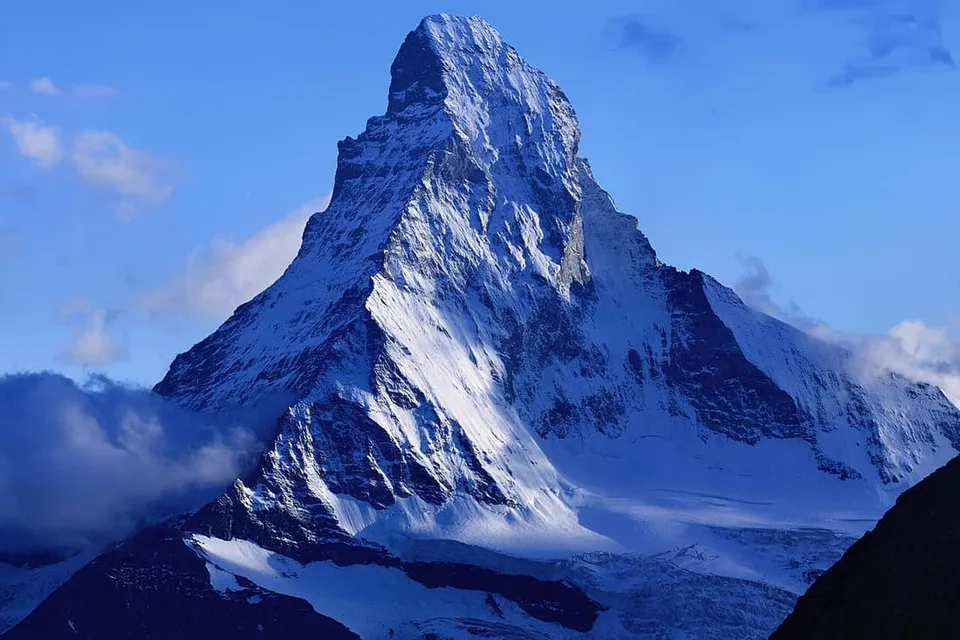
Matterhorn at a glance
- Elevation: 4,478 m (14,692 ft)
- Prominence: 1,043 m above its key col
- Range: Pennine Alps
- Country: Switzerland / Italy · Europe
- First recorded ascent: 14 July 1865 — Edward Whymper's party; four of the seven died on the descent
- Also known as: Cervino (Italian) · Cervin (French)
How to recognise Matterhorn by eye
The most recognisable silhouette in the Alps — a lone, slightly hooked rock pyramid. It overlooks Zermatt, Switzerland to the northeast and Breuil-Cervinia, Italy to the south; from Zermatt the hooked profile is unmistakable.
Why Matterhorn matters
The Matterhorn is a large, near-symmetric pyramidal peak whose four faces each roughly point toward one of the cardinal directions. It has become the iconic emblem of the Alps, and its 1865 first ascent — which killed four of the seven-man party on the way down — marked the end of the golden age of alpinism.
Related peaks
- Mont Blanc — 4,805.59 m, Graian Alps.
- Mount Fuji — 3,776.24 m, Free-standing active stratovolcano on Honshu.
- Mount Kilimanjaro — 5,895 m, Free-standing dormant stratovolcano (three cones: Kibo, Mawenzi, Shira).
New to peak-spotting? Start with our guide to how to identify a mountain.
Source
Elevation, prominence, range and ascent facts per Matterhorn — Wikipedia (accessed July 4, 2026). Where Wikipedia itself qualifies a figure (surveys change, snow caps shift), the qualification is preserved above rather than rounded away.