
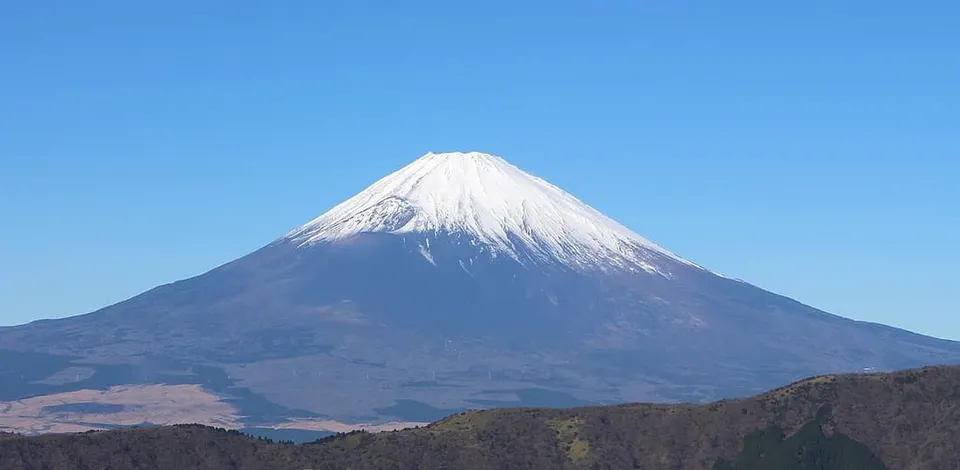
Mount Fuji at a glance
- Elevation: 3,776.24 m (12,389 ft)
- Prominence: 3,776 m above its key col
- Range: Free-standing active stratovolcano on Honshu
- Country: Japan · Asia
- First recorded ascent: Traditionally attributed to the ascetic En no Odzunu (663 AD); the first well-documented Western ascent was Rutherford Alcock's, September 1860
- Also known as: Fujisan (富士山)
How to recognise Mount Fuji by eye
The textbook symmetric volcanic cone, usually snow-capped. It stands about 100 km southwest of Tokyo, and on clear days is visible from Tokyo and Yokohama — sometimes from as far as Chiba, Saitama and Lake Hamana.
Why Mount Fuji matters
Mount Fuji is Japan's highest mountain, an active stratovolcano with an exceptionally symmetrical cone that is snow-covered for about five months of the year. It has inspired artists and poets and been an object of pilgrimage for centuries.
Related peaks
- Mount Kilimanjaro — 5,895 m, Free-standing dormant stratovolcano (three cones: Kibo, Mawenzi, Shira).
- Aconcagua — 6,967.15 m, Principal Cordillera, Andes.
- Mount Rainier — 4,391 m, Cascade Range.
New to peak-spotting? Start with our guide to how to identify a mountain.
Source
Elevation, prominence, range and ascent facts per Mount Fuji — Wikipedia (accessed July 4, 2026). Where Wikipedia itself qualifies a figure (surveys change, snow caps shift), the qualification is preserved above rather than rounded away.